How to Play
Tectonic
Tectonic, also known as Suguru, is a number puzzle on a grid divided into regions. Fill every region with the numbers from 1 up to its size, and never let two equal numbers touch, not even diagonally.
Rules
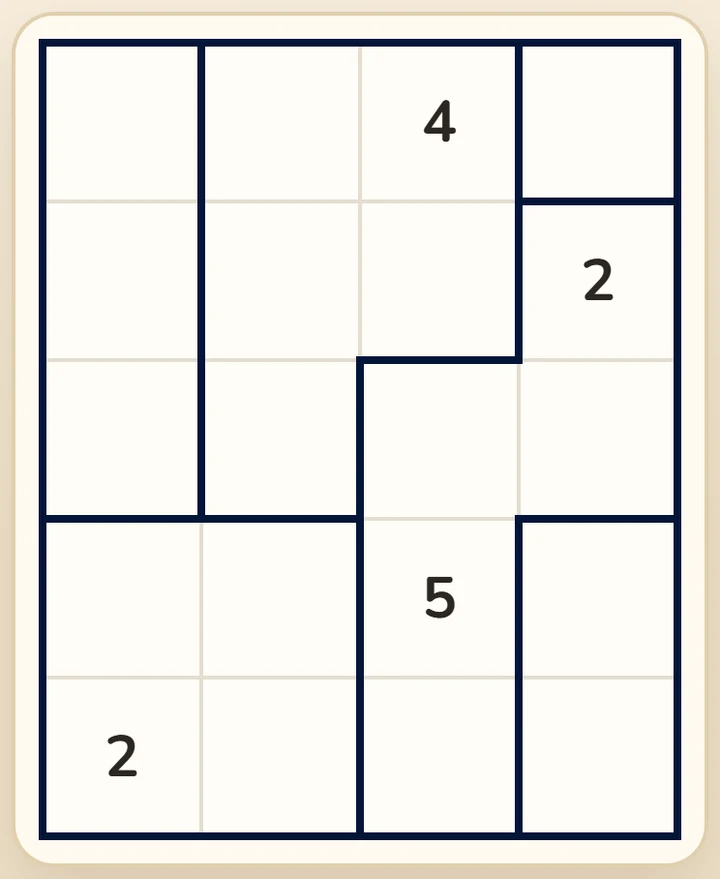
- The grid is 4 columns wide and 5 rows high, divided into regions by thick lines.
- A region with s squares must contain each number from 1 to s exactly once. A one-square region is just a 1, and the biggest region here has 5 squares.
- The same number may never appear in two touching squares. Touching includes diagonals, so every square has up to eight neighbors.
- Some numbers are given at the start; the rest follow from logic alone.
- There is a new board every day, and it is always solvable without guessing. The difficulty (easy, medium or hard) is shown next to the day number.
Tips & Strategy
- Start with regions of one square, which are always a 1, and cross that 1 off in all eight squares around it. Then look at small regions, which leave few options. A two-square region holds exactly a 1 and a 2, so once you know one square, you know the other.
- Use the touching rule to eliminate numbers. A square next to a 3, even diagonally, cannot be a 3 itself. Tap the same number a second time to turn it into a pencil note, and keep track of what is still possible in each square.
- Look for squares where only one number is left. You can fill those in right away, and each new number rules out more options in the squares around it.
- Check which numbers a region still needs and where they can go. If a number fits in only one square of the region, it has to go there, even if that square could also hold other numbers.
Frequently Asked Questions
- Do I ever need to guess in Tectonic?
- No. Every board has exactly one solution, and it can always be found by deduction. If you get stuck, look for a number that fits in only one square of a region, or add pencil notes and cross off the numbers next to each square.
- How hard is each day's board?
- It changes from day to day. Some days are easy, some medium and some hard, picked at random, and the level is shown next to the day number. Harder boards give fewer numbers at the start and need trickier deductions.
- Why do diagonal squares count as touching?
- That is how the puzzle is designed. The diagonal neighbors tie each region to the ones around it, so a number in one region rules out squares in the next. Check all eight neighbors of a square before you place a number.