How to Play
Sudoku
Sudoku is the classic 9×9 number placement puzzle. Fill the grid so every row, column, and 3×3 box contains each number from 1 to 9 exactly once.
Rules
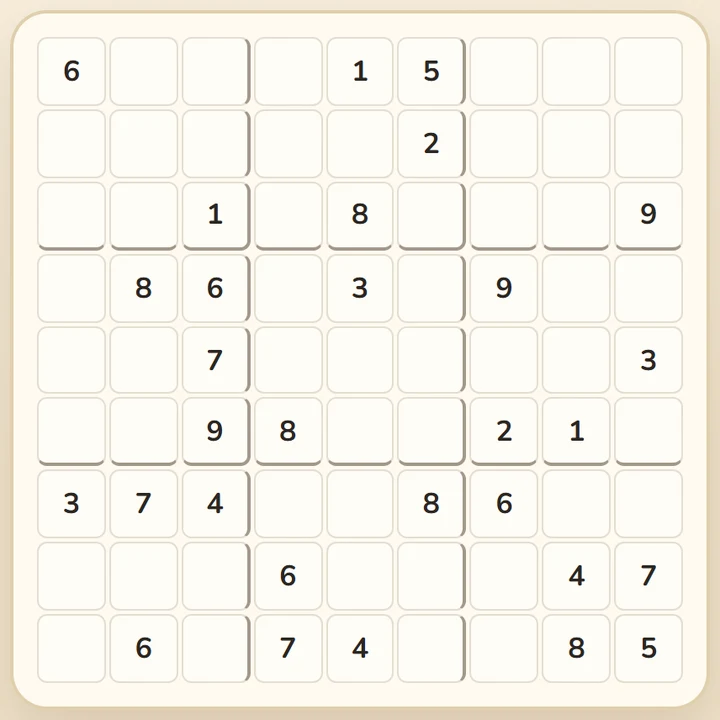
- The grid is 9 rows by 9 columns, split into nine 3×3 boxes.
- Every row must contain the numbers 1 through 9, each exactly once.
- Every column must contain the numbers 1 through 9, each exactly once.
- Every 3×3 box must contain the numbers 1 through 9, each exactly once.
- Some numbers are given at the start, and the rest follow from logic alone. There is a new grid every day, and it is always solvable without guessing.
Tips & Strategy
- Scan for one number at a time across the whole grid ("where can every 7 go?") instead of looking at one square at a time. It's usually faster.
- Once the easy numbers are filled in, use pencil-mark notes to write down which numbers could still go in each square. A square with only one possible number left can be filled in right away.
- Look for a number that can only go in one square of a box, row, or column, even if that square could also hold other numbers. This is called a hidden single.
- When two squares in the same row, column, or box have exactly the same two possible numbers, those two numbers can be removed from every other square in that row, column, or box.
Frequently Asked Questions
- Is every daily Sudoku puzzle solvable without guessing?
- Yes. Every grid has exactly one solution, and techniques like scanning and hidden singles are always enough to find it, with no coin flip between two options.
- What's the difference between Sudoku and Mini Sudoku here?
- Sudoku is the full classic 9×9 grid with 3×3 boxes; Mini Sudoku is a faster 6×6 variant with 2×3 boxes, using the same rules at a smaller scale.
- Can I use pencil marks / notes?
- Yes, switch on note mode to jot down possible numbers in a square without committing to an answer, just like pencil marks in a paper sudoku.