How to Play
Nonogram
Nonogram, also known as Picross or Griddler, is a picture logic puzzle. Numbers next to each row and column tell you how many squares to paint, and in what order, to reveal a hidden image.
Rules
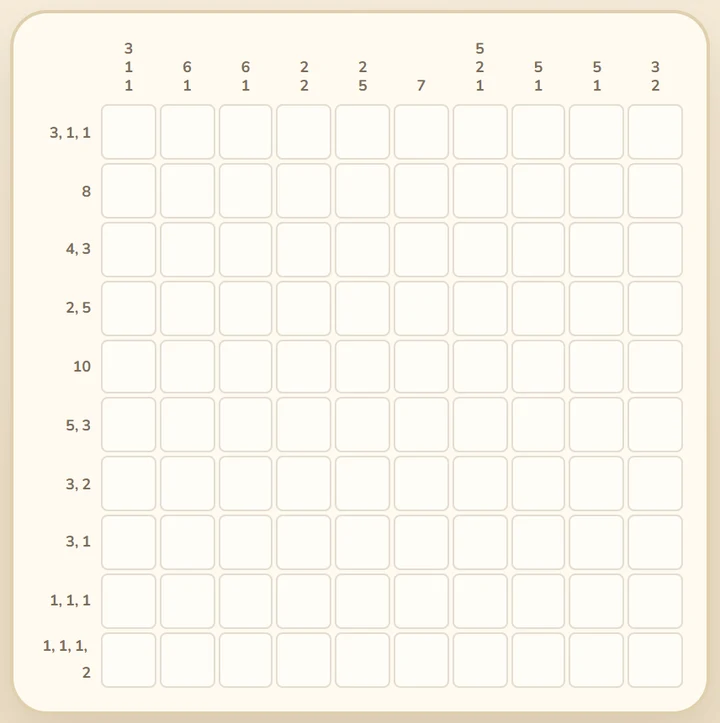
- Each row and column has a list of numbers, e.g. "3 1", meaning a run of 3 painted squares, then a gap, then a run of 1.
- Paint the squares that belong to the picture, and leave the rest empty, so every row and column matches its clue numbers exactly.
- The runs must appear in the same order as the numbers, with at least one empty square between them.
- Use Mark mode to X out squares you're sure are empty. It's only a memory aid and doesn't affect solving.
Tips & Strategy
- Start with rows or columns whose clue numbers, plus the minimum gaps between them, add up to nearly the full length of the line. Much of that line is then forced.
- Cross-reference: once you know a square is painted from its row, check what that implies for its column, and back again.
- Work the edges first. The first and last clue numbers in a line are the most restricted, since they sit against the edge of the grid.
- If a clue is a single large number close to the line's length, the squares in the middle of the line must be painted, wherever the run ends up.
Frequently Asked Questions
- What's the difference between Nonogram, Picross, and Griddler?
- They're all names for the same picture logic puzzle. Picross is Nintendo's trademarked name, Griddler is another common term, and Nonogram is the generic name used here.
- Do I need to guess to finish a Nonogram?
- No. The clue numbers on every row and column are always chosen so that the overlap logic above pins down the whole picture, square by square, with no blind guessing.
- What does marking a square with an X do?
- It's a personal note that a square is empty, like a pencil mark. It doesn't affect whether the puzzle counts as solved.