How to Play
Crowns
Crowns is a Queens-style logic puzzle, in the same spirit as LinkedIn's popular daily Queens game. Every day brings a brand-new grid split into colored regions. Your job is to place exactly one crown in every row, column, and region at the same time.
Rules
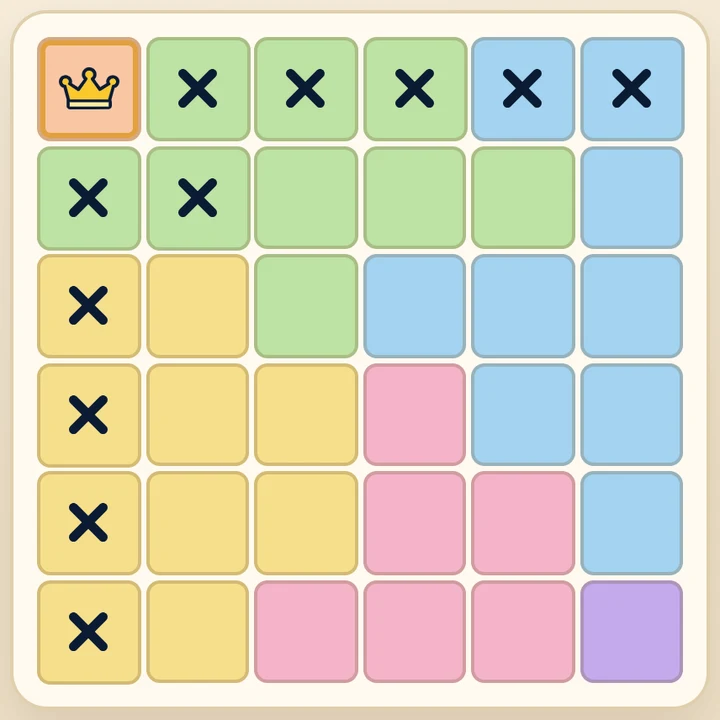
- The board is divided into colored regions. Place exactly one crown in every row, every column, and every colored region.
- No two crowns may touch, not even diagonally. Every crown needs the squares around it to be free of other crowns.
- There's exactly one valid arrangement each day, and it's always reachable through pure logic, never a guess.
- Tap a square once to mark it with an X (a note that a crown can't go there), tap again to place a crown, tap a third time to clear it.
Tips & Strategy
- Start with the smallest colored region. A region with only one or two squares often shows right away where its crown goes.
- Once a region's crown is placed, X out its whole row and column and the squares diagonally next to it. Each new X often lets you rule out more squares.
- If all the squares still open in a region are in one row or column, X out every other square in that row or column, even those outside the region.
- Work the edges and corners first. They have fewer neighboring squares, so they are usually the most restricted.
Frequently Asked Questions
- Is Crowns the same as LinkedIn Queens?
- Crowns is built in the same style as LinkedIn's daily Queens game: one crown per row, column, and colored region, with no two touching. It has its own grids, which are generated fresh and checked before they go live each day.
- Do crowns count diagonal adjacency?
- Yes. Two crowns can't be in neighboring squares, and that includes all eight squares around a crown, diagonals too. Crowns that are further apart in a row or column, with at least one square between them, don't count as touching.
- Is there always only one solution?
- Yes. Each day's grid has exactly one crown placement that satisfies every row, column, and region, and the elimination logic above is always enough to find it. No trial and error is needed.