How to Play
Binario
Binario is a Tango-style binary grid puzzle, inspired by LinkedIn's Tango. Fill every square with one of two symbols so that every row and column has the same number of each symbol and no three identical symbols sit next to each other.
Rules
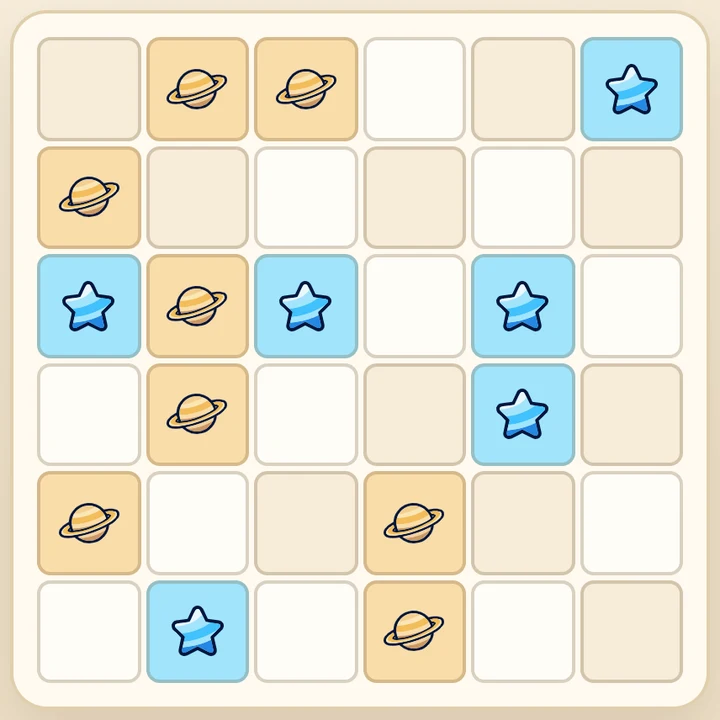
- Fill every empty square with one of two symbols (shown as a star or a planet).
- Every row and every column must end up with an equal number of each symbol.
- Never place three of the same symbol next to each other in a row or column. Two side by side is fine, three never is.
- No two rows can be identical to each other, and no two columns can be identical to each other.
- Some squares are given at the start as fixed clues; the rest follow from pure logic.
Tips & Strategy
- Whenever you see two of the same symbol next to each other, the squares immediately on either side must be the other symbol, otherwise you'd make three in a row.
- Count symbols in a row or column as you go: once one symbol reaches half the row's length, every remaining empty square in that row must be the other symbol.
- Watch for a row or column that is one square away from being identical to another one. That last square must get the other symbol.
- Work row-by-row and column-by-column rather than jumping around; the balance-count rule is easiest to track that way.
Frequently Asked Questions
- Is Binario the same as LinkedIn Tango?
- Binario follows the same rules as LinkedIn's Tango: balanced rows and columns, no three in a row, and no duplicate lines. It just has its own grid, generated and checked fresh each day.
- Can two in a row ever be wrong?
- No, two matching symbols next to each other is completely normal. It's three in a row that's never allowed.
- Do I ever need to guess?
- No. The balance rule and the no-three-in-a-row limit always narrow every empty square down to a single answer, so logic alone is enough to solve every daily puzzle.